Employee share schemes are usually introduced with a positive commercial purpose.
They help businesses attract talent, reward senior people and align employees with long-term value. In growth companies, professional firms and owner-managed businesses, share incentives can support succession planning, retention and eventual exit strategy.
But the tax administration is often less visible than the commercial objective.
That is where the risk sits.
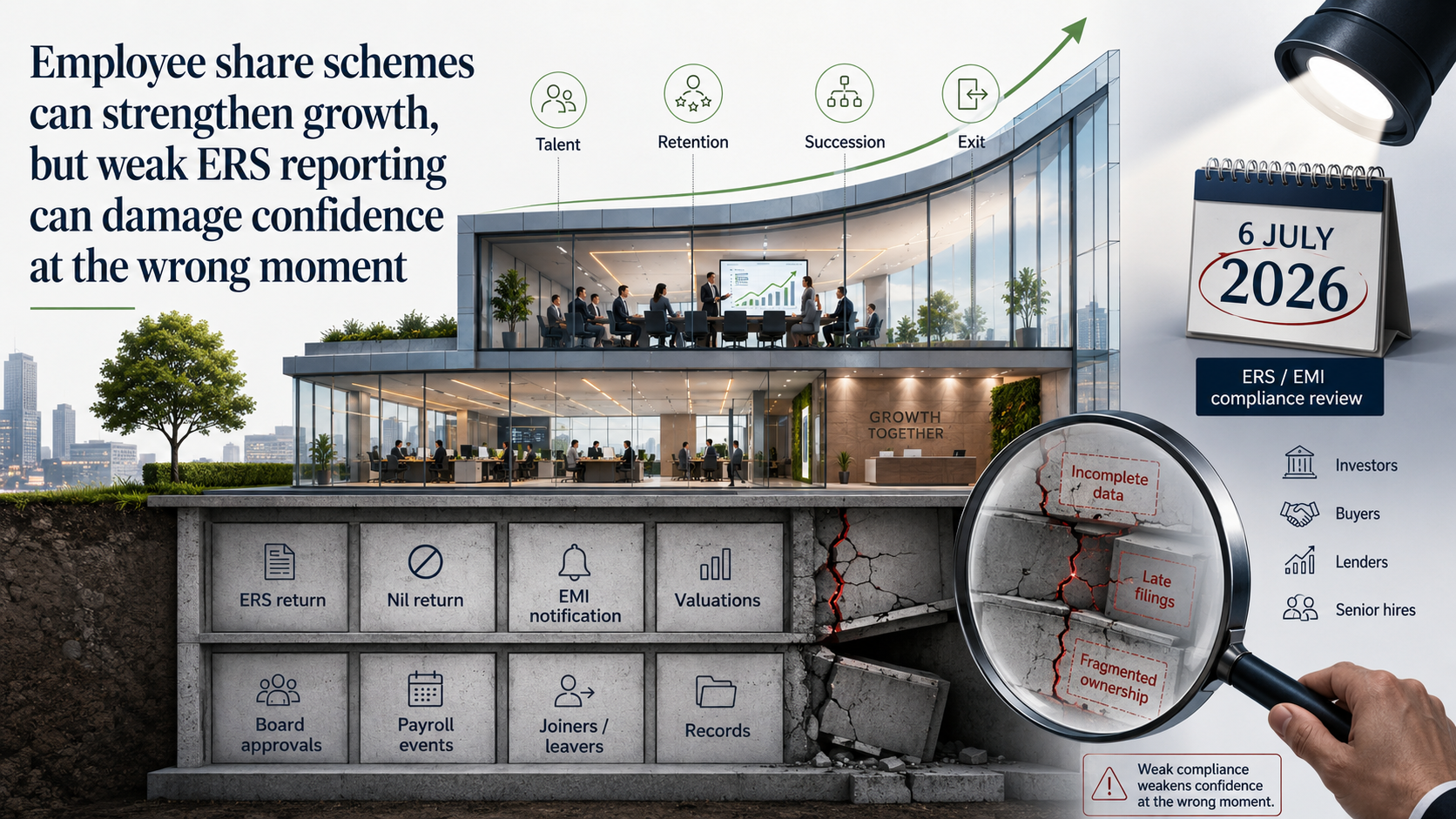
For the 2025 to 2026 tax year, employers operating registered employment related securities schemes must submit an end-of-year ERS return by 6 July 2026. HMRC has confirmed that a return or nil return is required for every scheme registered on the ERS online service.
For companies using Enterprise Management Incentives, there is an additional deadline.
HMRC’s Employment Related Securities Bulletin 65 confirms that EMI options granted during the 2025 to 2026 tax year must be notified by 6 July 2026. It also confirms that end-of-year returns for all live EMI schemes must be submitted by 6 July 2026.
This deserves board-level attention.
Especially where a business expects future investment, sale, restructuring or senior recruitment.
Share scheme risk rarely starts with the tax return
Most ERS problems do not arise because a company deliberately ignores the rules.
They arise because responsibility is fragmented.
Legal advisers may draft the documents. Accountants may support valuation or filing. Payroll may process taxable events. HR may manage joiners and leavers. Finance may maintain share and option records. Directors may approve awards before the reporting trail is fully organised.
Each function may see part of the picture.
Nobody may own the whole record.
That creates practical risk.
Option grants may not be notified correctly. Leaver events may not be captured. Restrictions may be misunderstood. Exercises may not be linked to payroll treatment. Nil returns may be overlooked because directors assume that “nothing happened” means “nothing to file”.
For HMRC purposes, that assumption can be costly.
Why this matters commercially
ERS compliance is not just about avoiding penalties.
It affects confidence.
A buyer, investor or lender reviewing a business will often look closely at share incentives. They will want to know who owns what, what has been promised, whether tax-advantaged status has been protected and whether reporting obligations have been met.
Weak records can slow down due diligence.
They can also create negotiation pressure. If share scheme documentation, valuations or filings are incomplete, a buyer may seek warranties, indemnities, price adjustments or additional protections.
In professional firms, the reputational point may be sharper. Accountancy firms, legal practices, wealth managers and advisory businesses are expected to maintain strong governance over their own tax affairs.
A missed ERS return may appear small.
But it can suggest weak internal control.
EMI needs particular care
EMI remains one of the most valuable tax-advantaged share incentive arrangements available to qualifying companies.
That value depends on compliance.
The notification deadline matters because late or incorrect administration can create uncertainty over tax treatment. In practice, the problem often becomes visible later: when an employee exercises options, when the company is sold or when due diligence asks for evidence.
By then, correction may be harder.
This is why EMI should not be treated as a one-off legal document exercise.
It needs an annual compliance review supported by clear records of grants, valuations, board approvals, employee eligibility, working time requirements, leavers and disqualifying events.
What good governance looks like
A robust ERS process does not need to be over-engineered.
It should include:
• a central register of all share awards and options
• a named internal owner
• annual adviser review
• evidence of valuations and approvals
• a checklist for joiners and leavers
• payroll review for taxable events
• confirmation of nil return requirements
• a clear timetable leading to 6 July 2026
Where the company expects growth, fundraising or exit activity, the standard should be higher.
Records should be maintained in a form that can withstand due diligence, not merely satisfy a last-minute filing requirement.
Final takeaway
Employee share schemes can be powerful commercial tools.
But their tax value depends on disciplined administration.
Before 6 July 2026, companies should complete an ERS and EMI compliance review, confirm whether nil returns are required and ensure the evidence trail would stand up to HMRC scrutiny or investor due diligence.
Good tax advice does not end when the share scheme is created.
It is tested in the years that follow, through disciplined records, timely filings and the ability to prove, under scrutiny, that the scheme still works as intended.