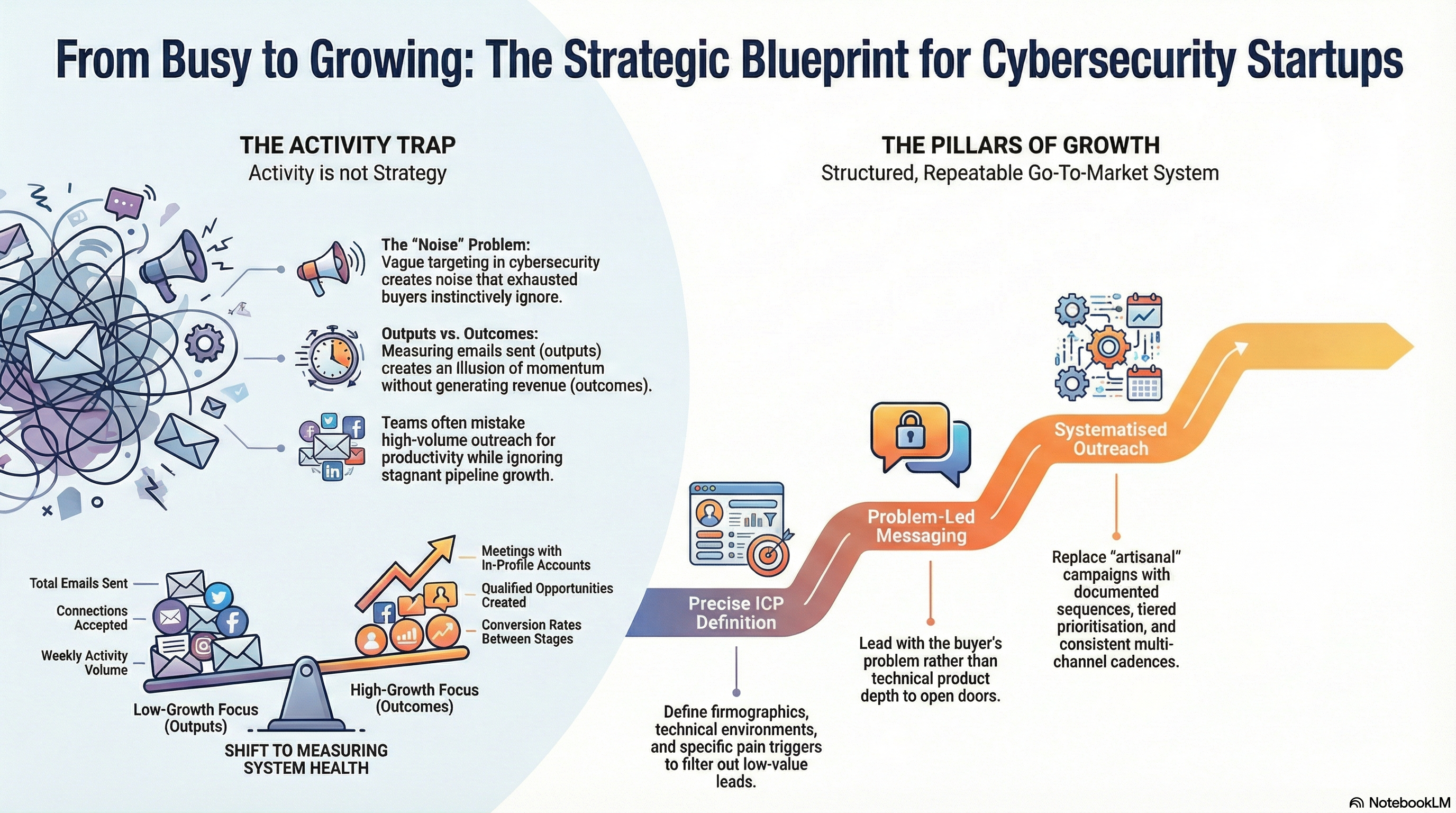
Why Most Tech & Cybersecurity Startups Are Busy — But Not Growing
There's a trap that swallows early-stage startups whole.
It looks like productivity. It feels like hustle. Teams are sending emails, booking calls, attending events, posting content, chasing leads. Everyone is moving. Everyone is tired. And yet, at the end of the quarter, the pipeline is thin, the numbers don't stack up, and nobody can quite explain why.
The answer is almost always the same: activity was mistaken for strategy.
You can measure growth. You can't measure being busy.
The Real Foundation: Knowing Exactly Who You're Talking To
Before a single email is sent or a single call is booked, everything in go-to-market outreach depends on one thing — a precise, honest definition of your Ideal Customer Profile (ICP).
Not a vague persona. Not "mid-market companies in financial services." A real, working definition that tells you the firmographic attributes, the technical environment, the pain triggers, the internal stakeholders, and the conditions that make a prospect ready to buy right now.
In cybersecurity especially, this matters more than almost any other sector. The buyer universe is fragmented — CISOs, IT Directors, procurement teams, compliance officers — and each has different priorities, different languages, and different thresholds for risk and vendor trust. Trying to talk to all of them at once, with the same message, is not outreach. It's noise.
A well-defined ICP does something invaluable: it lets you say no. It filters out the accounts that will drain your time and never convert, and it focuses your energy on the accounts where you have a genuine right to win.
Without it, you're not running outreach. You're running a lottery.
Clarity: The One Non-Negotiable
The most common failure point in go-to-market for tech startups is unclear messaging. Founders who deeply understand what they've built often assume that understanding translates automatically into communication. It doesn't.
Your prospect does not know your product. They do not know your category. They are receiving dozens of outreach messages a week from vendors who all claim to be different, transformative, and essential. The only question that matters to them in the first three seconds of reading your message is: is this relevant to a problem I actually have?
Clarity means answering that question immediately and specifically. It means leading with the problem, not the product. It means speaking in the language of the buyer's world, not the language of your internal roadmap. It means removing every line of copy that you wrote to impress rather than to connect.
In cybersecurity, clarity is even harder to achieve because the temptation is to lean on technical depth as a proxy for credibility. Technical depth has its place — but it belongs in the sales conversation, not in the cold outreach that gets you there.
The message that opens the door is always simple. The conversation behind the door can be as sophisticated as it needs to be.
Consistency: The Principle That Compounds
One of the most damaging myths in startup sales culture is that a clever campaign or a single brilliant sequence can generate a pipeline. It rarely does.
What generates pipeline is consistency — a structured, repeatable cadence of outreach that keeps the right message in front of the right accounts over time, without wavering every time results don't arrive immediately.
This is where most teams break down. They launch a sequence, see modest early returns, and pivot — new messaging, new channels, new targeting. Each pivot destroys the signal they were beginning to build. They never let anything run long enough to understand whether it was working or not.
Consistency is not stubbornness. It means establishing a cadence across touchpoints — email, LinkedIn, phone, events, content — and running it with enough discipline that you can actually measure what's happening. It means your brand and your message feel coherent to a prospect who encounters you across multiple channels over several weeks, rather than random and disconnected.
In a sector like cybersecurity, where trust is the ultimate purchasing criterion, consistency is also how you build credibility before the first conversation. Buyers are assessing you long before they respond. Showing up repeatedly, with a clear and relevant message, signals that you are a serious organisation — not another vendor chasing a quick close.
Structure: Turning Effort Into a System
Effort without structure is expensive. It burns through SDR time, founder attention, and marketing budget without producing the compounding returns that a real go-to-market engine delivers.
Structure means building outreach as a system — one with defined stages, clear ownership, documented sequences, and measurable outputs at every step. It means knowing your conversion rates from first touch to meeting, from meeting to qualified opportunity, from qualified opportunity to closed deal. It means understanding where prospects drop out, and having a hypothesis about why.
For tech and cybersecurity startups, structure typically requires several elements working in concert:
Account prioritisation — a tiered list of target accounts ranked by fit against your ICP, so that the highest-effort outreach is always directed at the highest-potential accounts.
Sequenced cadences — a defined series of touchpoints across channels, with deliberate spacing and a clear purpose for each step. Not spray-and-pray. A sequence with logic behind it.
Personalisation at scale — the ability to make outreach feel relevant and researched without requiring a bespoke hour of work per account. This means building templates that allow for meaningful personalisation at the account and persona level, not just first-name insertion.
Feedback loops — regular review of what's working and what isn't, based on data rather than intuition. Open rates, reply rates, meeting rates, and disqualification reasons all tell you something. Most startups don't look.
Handoff protocols — clear definitions of when a prospect moves from marketing to sales, what information travels with them, and what happens if they go dark.
Without these elements, outreach is artisanal. Every campaign is rebuilt from scratch. Every SDR operates on instinct. And growth, if it comes, is accidental rather than engineered.
Measuring Progress, Not Activity
The shift from busy to growing happens when a team starts measuring outcomes rather than outputs.
Outputs are easy to count and easy to inflate. Emails sent. Calls made. Connections accepted. Content posted. These numbers feel good on a weekly update slide. They create the impression of momentum. And they tell you almost nothing about whether your go-to-market is working.
Outcomes are what matter. Meetings booked with in-profile accounts. Qualified opportunities created. Revenue generated. And — critically — the conversion rates that connect each stage to the next, because those rates reveal the health of every part of your system.
A startup that sends 500 emails a week and books three meetings has a messaging problem, or a targeting problem, or both. A startup that sends 150 emails a week and books twelve meetings has a system that scales. The only way to know which one you are is to measure the right things.
This is why structure precedes measurement. You cannot measure a process you haven't defined. And you cannot improve a process you cannot measure.
The Competitive Reality in Cybersecurity GTM
Cybersecurity is a uniquely challenging go-to-market environment for startups. Buyers are fatigued by vendor outreach. They are sceptical of claims. They have been burned by tools that promised transformation and delivered complexity. And they operate in an environment where the wrong purchase decision can have consequences that extend far beyond a wasted budget.
That environment rewards a specific kind of outreach: specific rather than generic, credible rather than promotional, patient rather than pressured.
It punishes the opposite: broad targeting, hyperbolic claims, high-volume sequences that treat every prospect the same, and any approach that prioritises velocity over fit.
A structured, ICP-led approach is not just good practice in this sector. It is a competitive differentiator. While competitors are flooding inboxes with generic sequences, a startup that shows up with the right message, for the right problem, at the right account, stands out by default.
The Summary That Should Sit Above Every Outreach Plan
Define your ICP precisely. Speak to one problem, one person, with absolute clarity. Show up consistently across channels and over time. Build the system before you scale the effort. And measure outcomes, not activity.
Growth in go-to-market is not a mystery. It is a compound effect — the result of doing the right things, in the right order, with enough structure and discipline to learn and improve.
The startups that scale are not the ones that work hardest. They are the ones that build the best systems, define the clearest targets, and stay consistent long enough for those systems to work.
Stop measuring how busy you are. Start measuring how much you're growing.
Fractional Go To Market Services Ltd
#cybersecurity #startups #gtm #growth #founders